Story behind me
getting the lens
After entering Samyang’s Passionate competition in July it
was announced on July 22
nd that I had been awarded along with two
other photographers (worldwide) with the ‘Samyang Passionate’ sponsorship
program. I would receive the brand new
AF 50mm F1.4 FE lens for Sony E-mount.
Finally receiving
the lens
 |
| Samyang AF 50mm F1.4 FE mounted on my Sony A7R |
Fast forward a few weeks of intense anticipation (I was like
a child on Christmas Eve) and I am now in possession of this brand new
autofocussing lens. One of only two autofocussing lenses that Samyang have ever
made which had only released in August as part of their
Summer Blockbusters
line-up (the other being the
14mm F2.8 AF lens). Check out my unboxing video
HERE.
Info and specs
This lens has been built for use on mirrorless cameras. The
back focus distance is reduced to take into account mirrorless cameras.
Therefore, the lens can have its rear element close to the sensor, without
having to resort to a retrofocus design to make room for the mirror box
assembly on a DSLR. This brand new Samyang weighs in at 585g compared to some
conventional DSLR 50mm f/1.4 lenses that can weigh as little as 220g. The lens
comes with a plastic lens hood and has a 67mm filter thread. For the interior
construction of the lens there are 9 elements in 8 groups, three of which are
aspherical and it features a rounded 9 blade diaphragm which creates silky,
smooth ‘Bokeh’ (out of focus areas of the image). It has a minimum focusing
distance of 0.45m (1.47 feet), a maximum magnification of 0.15x.
 |
| Size in hand (I don't have the biggest of hands) |
Initial thoughts
My initial thoughts on the lens are that it has a good build
quality being made mainly of metal with a high quality plastic lens hood. It
feels solid in construction and at 9.77cm in length it seems to balance very
well when mounted on my Sony A7R with
Meike battery grip. It’s worth noting
that the Samyang is larger and heavier than both the
Sony FE 50mm F1.8 and the
Carl Zeiss Sonnar T* FE 55mm F1.8 ZA but that doesn’t bother me at all as I’m
used to bigger and heftier pieces of glass being mounted to my
A7R with an additional
adapter. I do however understand that mirrorless camera systems are intended to
be smaller in terms of body and lens overall footprint.
 |
| Size
comparison - (from left to right) Samyang 8mm F3.5 Fisheye, Samyang AF
50mm F1.4, Canon 16-35mm F4L IS, Sony Zeiss 24-70mm F2.8 |
|
Autofocus
Having never owned a native E-mount lens I was used to
dealing with less than speedy focussing using my adapted A-mount glass on my
A7R. All my lenses are usually mounted via
Sony LA-EA4 adapter so the AF can
tend to hunt a little especially in low light. Having said that I have always
found my
Sony Zeiss 24-70mm f2.8 lens to work perfectly fine in terms of
autofocussing while mounted to my A7R via LA-EA4 adapter. As a result it was
great to be able to test out the autofocussing speed of this E-mount Samyang
lens. My initial testing has shown the AF to be very responsive and
accurate even in low light situations which is where such a fast lens in terms
of maximum aperture should shine.
 |
| Old Samyang MF 8mm F3.5 Fisheye (Sony A-mount) next to the Brand New AF 50mm F1.4 FE |
Looking at some of
the images I’ve shot with the lens
I’ve tried to shoot a variety of subjects and scenarios with
this lens from fast moving unpredictable toddlers (my nearly 2 year old son,
Lucas) to things that don’t move at all. I’ve been left very impressed by the
lens’ ability to lock on focus (while in AF-C mode) bearing in mind that the
A7R is not renowned for boasting a speedy autofocussing system. The only thing I'm yet to test with this lens is the 'sweet spot' areas of aperture (typically around f8) and also the narrower end of the the aperture end (f16). The reason being that I only tend to use lenses that have a wide maximum aperture at their widest points as I'm a sucker for shallow depth of field. Take a look at
the test images I shot and feel free to leave a comment below.
 |
| 1/800sec - f1.4 - ISO 100 |
 |
| 1/1600sec - f1.6 - ISO 100 |
 |
| 1/400sec - f2.2 - ISO 100 |
 |
| 1/1600sec - f2.2 - ISO 100 |
 |
| 1/1600sec - f1.4- ISO 100 |
 |
| 1/3200sec - f2 - ISO 200 |
 |
| 1/1250sec - f2.2 - ISO 160 |
 |
| 1/160sec - f2 - ISO 400 |
 |
| 1/500sec - f5.6 - ISO 100 |
Conclusion
I have read on other reviews that this lens can produce
some
chromatic abberation (“
fringes"
of color along contrasting dark and bright areas of an image) but I have not seen
evidence of this from the small number of images I have taken with it. However,
this is a simple one-click fix in Lightroom. In fact, I have a preset for
whenever I import images into Lightroom that automatically removes chromatic
aberration. During my short time with this great lens I’ve been left
mesmerised with the sharpness of the images it produces, wowed by the creamy
bokeh when used wide open and very impressed with its autofocussing speed and
accuracy. I look forward to using this lens more and getting used to its
capabilities while safe in the knowledge that it can create stunningly sharp
images.
Special thanks to Karin at
Samyang Lens Global and Jane at
Intro 2020 for supplying me with the lens.
For more information on Samyang products please take a look at their website -
samyanglensglobal.com and subscribe to their newsletter to keep up to date with product news.
Follow me on my social media channels:

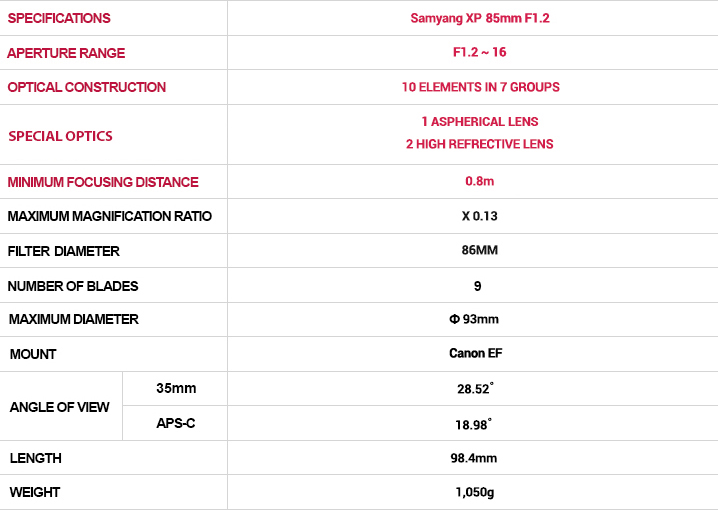 Build quality for this lens is as you can imagine very similar to the 14mm
f2.4 XP that I recently tested. It's made of aluminium alloy so is very solid.
It has a similar long throw rubber focus ring like the 14mm f2.4 XP that I
recently tested. Great for focussing on your subject precisely. However the
rubber does attract dust a little but not much of an issue as it can be cleaned
fairly easily. Weighing in at 1050g this lens is quite a heavy piece of glass
compared to the 791g of the 14mm f2.4. The 85mm has less glass than the 14mm
and is made up of 10 elements in 7 groups - including one aspherical lens and
two high refractive lenses. It has a minimum focus distance of 0.8m and a
filter thread diameter of 86mm so a very wide front element but what do you
expect for a lens with a maximum aperture of f1.2? The design of the lens
is in line with the 14mm f2.4 which shares a similarity with the Zeiss Milvus
range of lenses. The 85mm differs from the 14mm where it has a detachable lens
hood which is made of high quality plastic. Initially this lens will be
available in Canon EF mount only but hopefully Samyang will add Nikon and Sony
mounts to their line-up in the not too distant future to satisfy the majority
of the market. However, I have read somewhere that it would not be possible to
make this lens for Sony E-mount due to the bayonet not being wide enough to be
able to do f1.2. I hope that this isn't the case.
Build quality for this lens is as you can imagine very similar to the 14mm
f2.4 XP that I recently tested. It's made of aluminium alloy so is very solid.
It has a similar long throw rubber focus ring like the 14mm f2.4 XP that I
recently tested. Great for focussing on your subject precisely. However the
rubber does attract dust a little but not much of an issue as it can be cleaned
fairly easily. Weighing in at 1050g this lens is quite a heavy piece of glass
compared to the 791g of the 14mm f2.4. The 85mm has less glass than the 14mm
and is made up of 10 elements in 7 groups - including one aspherical lens and
two high refractive lenses. It has a minimum focus distance of 0.8m and a
filter thread diameter of 86mm so a very wide front element but what do you
expect for a lens with a maximum aperture of f1.2? The design of the lens
is in line with the 14mm f2.4 which shares a similarity with the Zeiss Milvus
range of lenses. The 85mm differs from the 14mm where it has a detachable lens
hood which is made of high quality plastic. Initially this lens will be
available in Canon EF mount only but hopefully Samyang will add Nikon and Sony
mounts to their line-up in the not too distant future to satisfy the majority
of the market. However, I have read somewhere that it would not be possible to
make this lens for Sony E-mount due to the bayonet not being wide enough to be
able to do f1.2. I hope that this isn't the case.


